Design Ops & Strategy
Structure for a team under pressure.
- Client
- Multidisciplinary organisation
- Role
- Design Program Manager
- Team
- A team of 25, working closely with the Director of Operations
- Date
- September to December 2025
A multidisciplinary team of 25 was receiving work with unclear priorities, timelines and briefs. Working closely with the Director of Operations, I designed how requests are received, scoped and managed.
- Decision
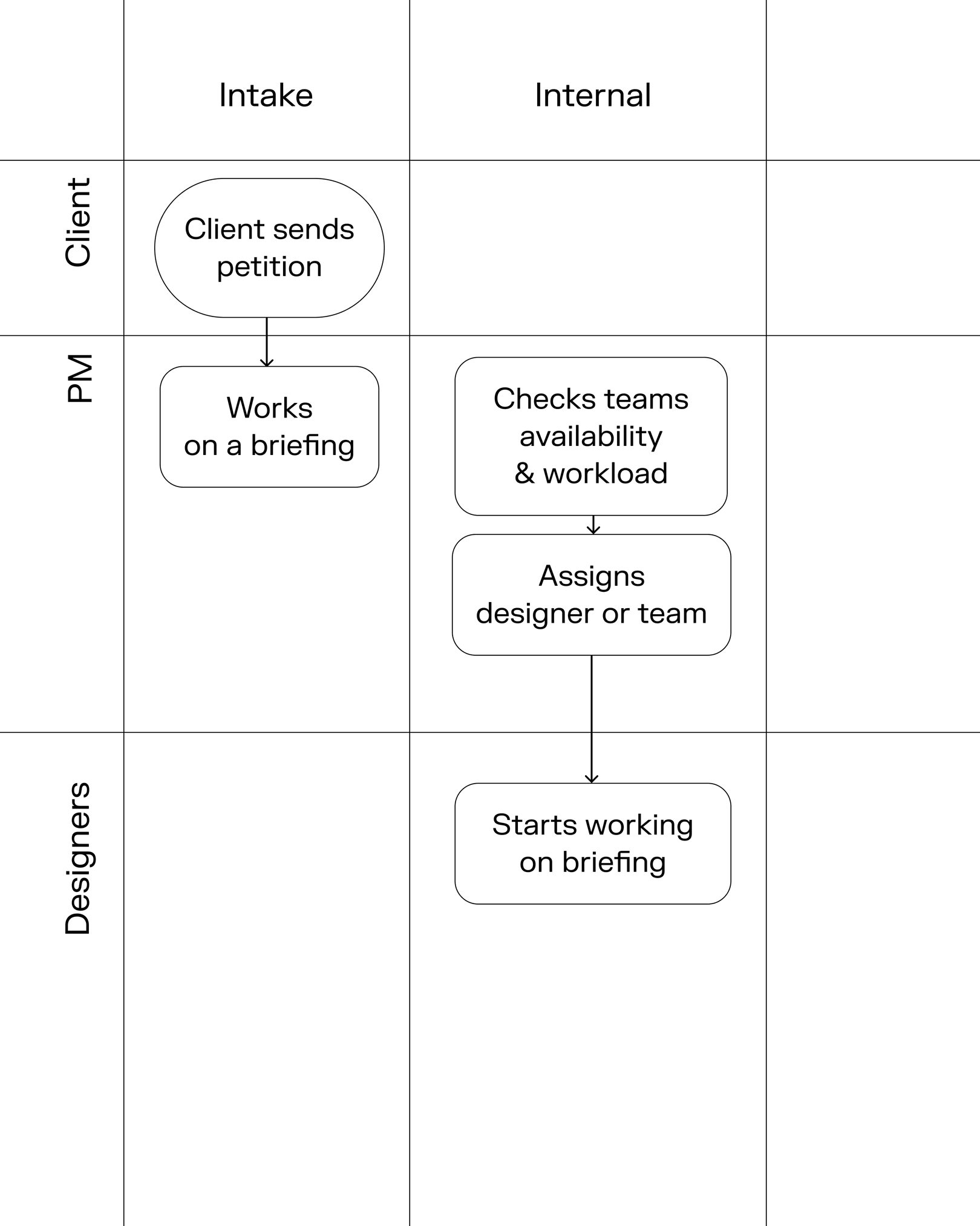
- I added a briefing step and shared complexity levels before work reached designers.
- Trade-off
- One more step at intake for every request.
- Status
- Framework handed over in December 2025. The team has since added dedicated project managers; I can't confirm it runs on my framework.
The challenge
Work that arrived unclear
Organisations running many client projects in parallel share a common problem: work arrives with varying levels of clarity. Requests may lack defined priorities, clear timelines or complete briefings, creating friction in client relationships and internal workflows. This multidisciplinary team dealt with high ambiguity and constant demand.
At the core was ambiguity: unclear requests, misaligned expectations, emotionally charged interactions with clients, and internal bottlenecks caused by centralised information flow. The goal was to bring structure to how requests were received, understood and managed, while balancing client expectations, team capacity and an evolving vision.
The work
Shape the request before the work
Rather than implementing a closed or final system, the focus was on setting a direction and creating the conditions for clearer decisions under uncertainty.
Structure incoming requests. Raw client demands were translated into clear, actionable briefings before reaching the team, enabling realistic effort estimates and early alignment.
Stabilise client communication. Interactions were reframed towards calm, fact-based responses, avoiding confrontation and setting a minimum line of professional respect.
Introduce project dimensioning. A shared language for levels of complexity and effort made conversations about scope and timelines more realistic.
Rethink the structure. We explored a more distributed and sustainable setup, identifying where centralised coordination created bottlenecks and how shared systems could enable autonomy.
Treat culture as infrastructure. Team rituals and informal practices were recognised as key to cohesion, trust and long-term sustainability.
The work gave the team a clearer way to receive, scope and manage projects. The organisation has since moved in the same direction, with dedicated project managers and a defined structure.
The first priority is always to stabilise delivery and protect the team. In parallel, I observe how work actually happens to design structures that reduce friction over time.
Strategic design can work beyond deliverables, shaping how organisations function, communicate and grow in contexts of uncertainty.